

PAC-SALUT module · Bowel health
Bowel diary
Follow your bowel rhythm and changes.
The bowel diary lets you record the rhythm and consistency of bowel movements and symptoms related to digestive health, to describe your progress in a language shared by patient and professional.

It uses the Bristol stool scale, which classifies stools into seven types according to their shape and consistency. The information can be useful to discuss changes in habits, diet, medication or symptoms with your health professional.
What you can record
- Bristol typeTypes 1 to 7, with a single tap.
- Straining, volume and urgencyOptional, to help spot patterns.
- DetailsBlood, mucus, abdominal pain, incomplete emptying, wind…
- Medication and notesAnything you want to discuss at your appointment.
How it works
- 1
Record
Lets you record each bowel movement with the date, time and Bristol scale type. When something is unusual, you can add details such as pain, urgency, straining, blood, mucus or medication.
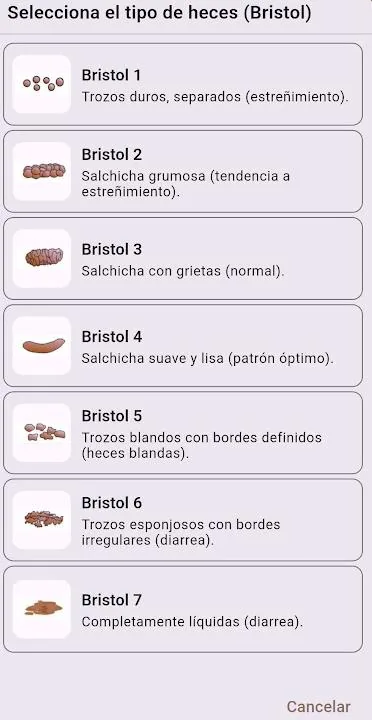
The Bristol type, with a single tap. - 2
See your progress
Charts show your progress by week, month or for the whole period, and help you see changes in frequency and consistency.
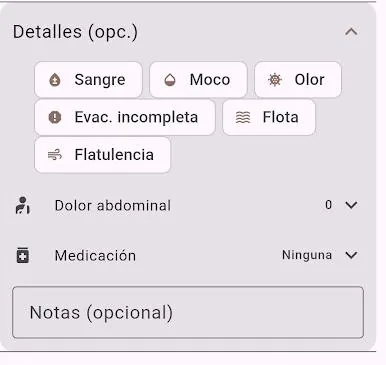
Progress by week or month. - 3
Share
The report summarises your weekly or monthly progress and counts the events recorded. The person chooses which charts to include in the PDF before exporting it.
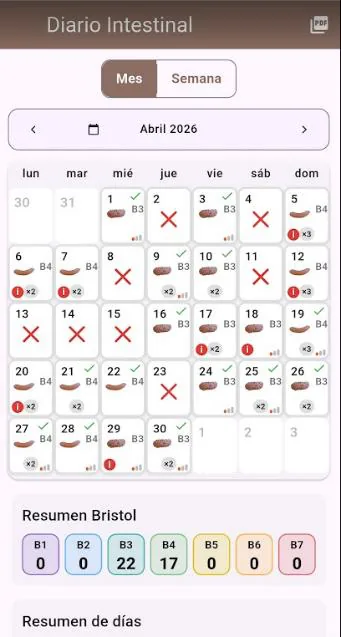
Summary with a count of events.
Sample report
This is what you take to your appointment. Real anonymised data. All reports →
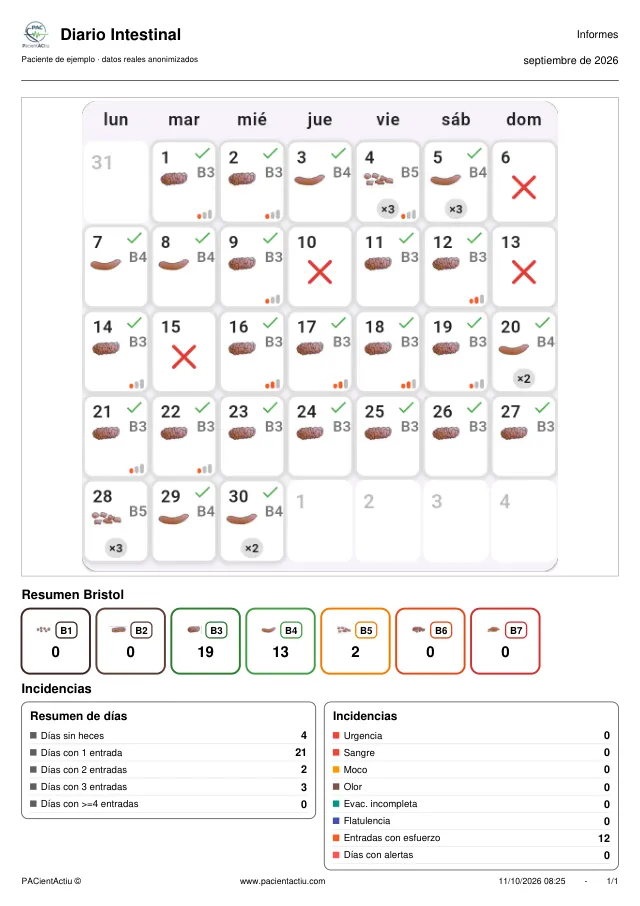 Bowel diary · reportCalendar with the consistency (Bristol) of each bowel movement, monthly summary and incidents.Open PDF ↗
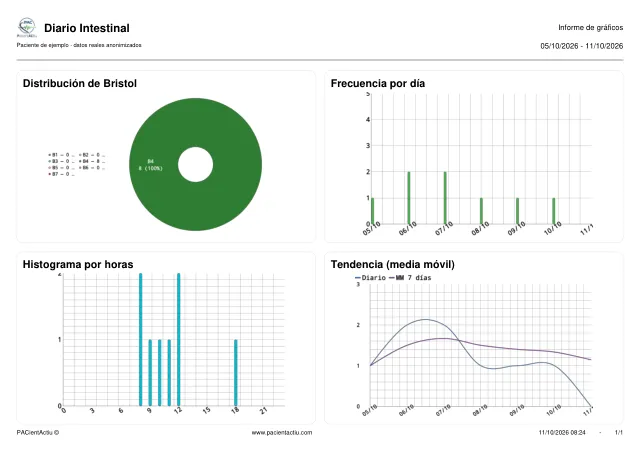 Bowel diary · chartsBristol distribution, daily frequency, timing and trend.Open PDF ↗
Good to know
- To start with, recording the Bristol type is enough.
- Add details when there is pain, urgency, diarrhoea or constipation.
- Consistency is more useful than completeness: a simple entry every day is better.
Frequently asked questions
How do I start using the bowel diary?
In four steps:
- Download PAC-SALUT from Google Play (Android).
- On the home screen, turn on the Bowel health module.
- After each bowel movement, tap the stool type selector and pick the closest type on the Bristol scale.
- Add details (pain, blood, urgency, medication…) only if something is unusual, and follow your progress in Charts and Reports.
What is a bowel diary?
It is a record of the rhythm and consistency of your bowel movements and related digestive symptoms. It helps describe how things evolve in a language shared by patient and professional, without relying on memory.
What is the Bristol stool scale?
It classifies stools into 7 types according to their shape and consistency. It was created in 1997 by Dr Stephen Lewis and Dr Ken Heaton at the Bristol Royal Infirmary. Types 3 and 4 are considered ideal; type 1 may indicate constipation, and types 6 and 7, diarrhoea. It is a descriptive reference, not a diagnosis.
Do I have to fill in every field?
No. To start with, the Bristol type is enough. Consistency matters more than completeness: a simple record every day is better than a complete one now and then.
Where is my data stored?
Only on your device. PACientActiu does not send your records to external servers and you do not need an Internet connection to enter them.